The glyphosate debate is asking the wrong question: lessons from Sheffield
With glyphosate's current approval in Great Britain running until 15 December while HSE considers renewal, the debate is louder than ever. But it is still mostly framed as glyphosate against the alter
The glyphosate debate is asking the wrong question: lessons from Sheffield
With glyphosate's current approval in Great Britain running until 15 December while HSE considers renewal, the debate is louder than ever. But it is still mostly framed as glyphosate against the alternatives. Sheffield has just shown that the biggest gains come from a different question altogether: what are the weeds growing in?
67% less glyphosate used on Sheffield's highways in 2026 so far, compared with 2025 |
39% fewer resident reports about silt and detritus, over 1,000 fewer reactive jobs |
8th in APSE's national benchmarking for footway weeds, with growth at 4.46% of surveyed locations |
Almost 2× the requests for extra weed treatment, 2021 to 2024, when spraying was cut without removing the growing medium |
What the national debate is missing
The House of Commons Library published a useful briefing on glyphosate on 29 October. It covers the health evidence, farming use, the renewal process and the UK–EU agreement that could bring GB pesticide rules into line with the EU's from mid-2027.
On towns and cities, though, it follows a familiar pattern. Councils are presented as choosing between glyphosate and alternative products: one council trying vinegar, another going herbicide-free amid "concerns about the effectiveness of alternative methods". The question is always what to kill the weeds with.
That framing misses what is actually working. Weeds on pavements and kerbs do not grow out of tarmac. They grow in the soil, silt and leaf litter that builds up along edges and in joints. Take that away, and there is far less to treat, whatever you treat it with.
Sheffield: the lesson from five years of trials
Sheffield's report to its Environmental Services and Regulation Policy Committee on 6 November tells the story clearly, and honestly.
The city began trying to reduce glyphosate in 2021, mainly by spraying less often. It did not work. Weeds were left to grow, residents complained, and reactive treatments filled the gap. Requests for extra weed treatment almost doubled, from 597 in 2021 to 1,143 in 2024. Glyphosate use actually rose, from 3,570 litres in 2021 to 4,865 litres in 2025.
So in 2026 Sheffield changed approach. Working with its highways contractor Amey, it linked weed treatment to a "deep clean" of every street, with the focus on removing the growing medium from the highway. The report cites Pesticide Action Network UK's recommendations and the Parks for London Integrated Weed Management Reference Guide, which I was glad to contribute to.
The results so far:
- Glyphosate use down around 67%, from 4,865 litres to 1,605 litres at the time of writing (a part-year figure, as the report notes).
- Better streets, independently measured: Sheffield ranked eighth in APSE's benchmarking for footway weeds.
- Fewer complaints: reports about silt and detritus down 39%, more than 1,000 fewer reactive jobs.
The lesson is simple. Spraying less, on its own, made things worse. Removing what the weeds grow in made things better on every measure at once.
Why the alternatives keep falling short
Sheffield's report is also candid about why simply swapping products has struggled. Over the years it has trialled hot foam, pelargonic acid, acetic acid and leaving streets untreated. In 2026 it trialled electric weeding, which it found kills weeds as well as glyphosate, but which is weather-sensitive and slow to cover a 1,922 km network. Officers modelled stopping glyphosate altogether at more than £2.4 million a year in extra cost, and up to £116 million in extra footway repairs by 2037.
That last figure deserves a closer look, because it is easily read as a reason to keep spraying. The modelling assumes glyphosate is what protects the footway. But spraying kills the weed and leaves everything else in place: the soil and silt it grew in, the moisture held against the surface, and the roots already working into joints. Most of the damage to footways comes from that growing medium, not from which product killed the last weed. A council that keeps spraying without removing it is likely to face much of that repair bill anyway. The real protection for the surface is taking the growing medium away, which is exactly what Sheffield's 2026 approach has started to do.
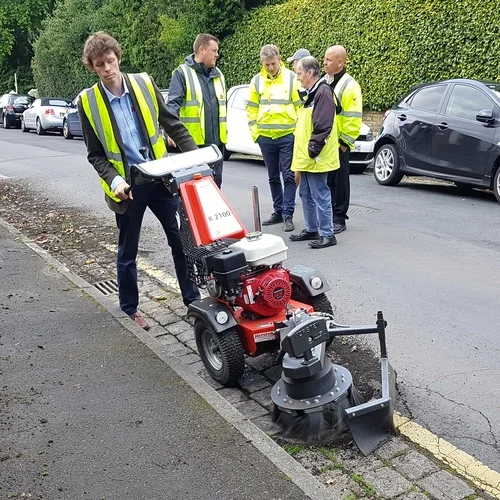
The national picture tells the same story. HortWeek's recent survey of UK councils, based on Freedom of Information requests, found that mechanical weeding is used by 187 councils and has been rejected by only 14. By contrast, hot foam, one of the best-known alternatives, is used by 15 councils and has been rejected by around 119. Mechanical brushing and sweeping is the method that removes the growing medium along with the weed, and it is the one councils keep.
The same survey found 19 councils that have stopped using glyphosate altogether, more than the 14 that have rejected mechanical weeding.
That is not a failure of any one technology. Almost every treatment, chemical or not, is being asked to deal with weeds rooted in years of built-up detritus. On clean, well-maintained surfaces, every method works faster and lasts longer. As I argue in The Weeds Are Not the Problem, much of Europe moved away from chemicals from that cleaner starting point, while Britain has been trying to do it on top of decades of accumulated material.
Not an isolated result
Sheffield is not alone. Cambridge City Council went from three herbicide applications a year to none, with mechanical cleansing at the heart of its programme. In the Bracknell trial, removing detritus before treatment cut the amount of herbicide used by 49%. The approach also fits the UK Pesticides National Action Plan, which asks amenity managers to adopt integrated pest management. On hard surfaces, that starts with the growing medium.

What this means for councils
- Whatever HSE decides in December, start with the growing medium. It reduces chemical use if glyphosate stays, and makes every alternative work better if it goes.
- Don't cut treatments without removing detritus. Sheffield's early years show that reductions alone push work into costly reactive visits.
- Link weed control and street cleansing. They are usually budgeted and managed separately, but they are the same job.
- Measure it. Track detritus and weed growth alongside chemical use and complaints, so you can show what is working.
The bottom line
The national debate asks what we should kill weeds with. Sheffield's results suggest a better question: why are they growing there at all? Answer that, and the glyphosate question becomes much smaller, whichever way the regulators go.
To talk about reducing herbicide use on your streets, or to arrange a demonstration, contact Kersten UK.
Sources: Sheffield City Council, Streets Ahead Glyphosate Strategy Update and 2027 Position, Environmental Services and Regulation Policy Committee, 6 November 2026. House of Commons Library, Glyphosate research briefing CBP-12265, 29 October 2026. HortWeek FOI survey of UK local authorities, October 2026. Parks for London, Integrated Weed Management Reference Guide (2025 edition). Bracknell IWM Trial.

No comments yet. Login to start a new discussion Start a new discussion